EECO2 has secured a United States patent for its Intelligent Cleanroom Control System, ICCS, providing pharmaceutical organisations with a new way to enhance compliance assurance while reducing energy use.
The US patent builds on a growing international portfolio, with ICCS patents already granted across Europe, Asia, China and Australia. This latest recognition in a rigorous jurisdiction reinforces the system’s relevance for global pharmaceutical manufacturers.
For engineering teams, ICCS improves system visibility and control. For quality leaders, it strengthens evidence of compliance. For sustainability teams, it enables meaningful energy and carbon reduction without added risk.
Cleanrooms are designed to reduce contamination risk, but most still rely on fixed airflow and periodic testing to prove control. This often leads to systems running conservatively, as performance between tests is assumed rather than continuously measured.
For many organisations, this creates a challenge. Reducing energy use is often seen as increasing compliance risk, as traditional systems do not provide the real time data needed to justify change with confidence.
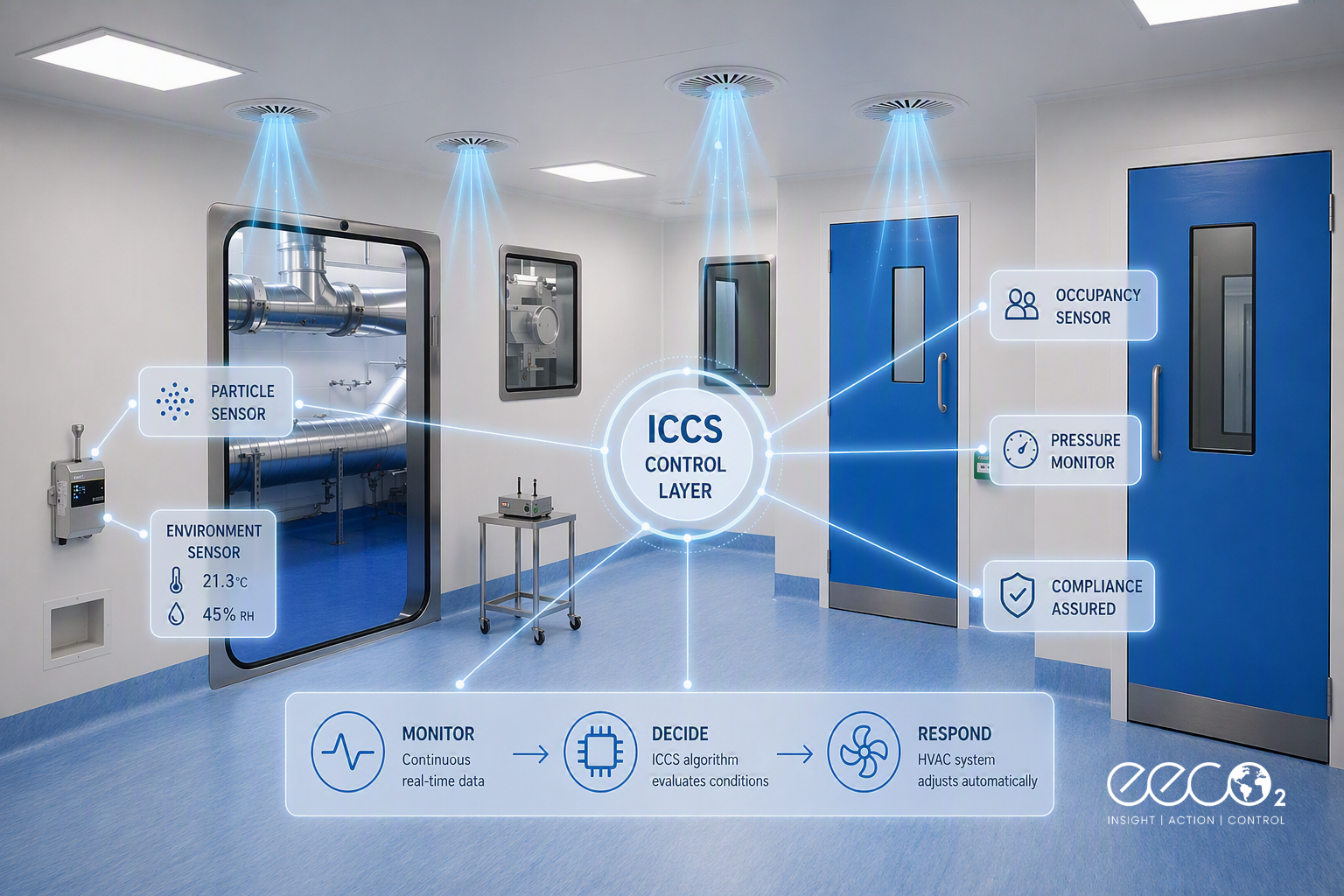
ICCS introduces continuous, data driven assurance. The newly granted US patent recognises a control method that uses live inputs, including particle concentration, occupancy, pressure and environmental conditions, to actively manage cleanroom performance.
Traditional systems infer compliance through fixed air change rates. ICCS shifts this to assured compliance, where conditions are continuously measured, controlled and evidenced in real time.
The system uses a bespoke control algorithm to adjust airflow, pressure, temperature and humidity based on actual contamination demand. This enables the cleanroom to maintain its ISO classification while continuously demonstrating control.
By linking monitoring directly to control response, the system identifies and manages issues as they occur. This includes filter degradation, pressure failures and overcrowding, which are often missed between periodic tests.
ICCS is already deployed in operational pharmaceutical environments. In facilities considered good practice, energy reductions of more than 60 percent have been achieved while maintaining validated conditions. This additional layer of compliance assurance is funded through reduced energy demand, making it both achievable and scalable.
Robert Wallace, co inventor of the ICCS method, said:
“Cleanroom control has traditionally relied on fixed assumptions to manage risk. With continuous data and adaptive control, it becomes possible to demonstrate compliance as it happens and respond immediately.”
The system strengthens Annex 1 Contamination Control Strategy requirements by providing continuous assurance and an auditable record of performance. It also supports a shift towards risk based requalification, reducing reliance on periodic testing alone.
ICCS integrates with existing building management systems and can be deployed with minimal disruption. Pre defined operating boundaries simplify qualification and reduce validation effort. In the event of a fault, the system reverts to full airflow, ensuring compliance is maintained.
The US patent forms part of a wider international portfolio and reflects recognition in a rigorous jurisdiction. It reinforces the system’s relevance for global pharmaceutical manufacturers.
The development reflects a shift towards actively demonstrated compliance, with energy savings enabling that improvement at scale.
About EECO2
EECO2 is a sustainability intelligence partner for pharmaceutical and life sciences organisations. The company helps reduce energy use, carbon emissions and operational risk through data led insight and practical engineering delivery.
© Copyright 2025 EECO2
Created by Summit Creative